Sounds
English has around 15 vowel sounds (it depends on the accent); Spanish has 5. Each week we master one sound you don’t have in your first language, so people understand you – and you understand them.
Vowel Play · English through Acting
Fun, theatrical classes where every new word comes with a movement, an emotion and a scene partner. You laugh, you cry, you play – and the English sticks.

What is Vowel Play?
Vowel Play is a method created by actor and teacher Isi Rodríguez. Instead of sitting behind a desk, you learn English by learning something fun at the same time: acting. We take great scenes, study them, put them on their feet and perform them. Along the way, the sounds, the words and the grammar of English become part of your body and your memory.
“Take the best film you’ve ever seen. We study it, we act it, you become an actor – and the by-product is that you learn English while you have a great time. You laugh, you cry… it’s incredible.”
– Isi Rodríguez, founder
English has around 15 vowel sounds (it depends on the accent); Spanish has 5. Each week we master one sound you don’t have in your first language, so people understand you – and you understand them.
We learn from the great works. Every class has a scene: we analyse it, find the intention, rehearse it and perform it. Words you have acted out are words you remember.
A safe space where everyone is on the same team. People of every origin and belief, learning to listen, to play and to support each other.
How a class works
Every class follows the same playful structure, so you always know what comes next and can focus on having fun.
Circle games and “Yes, let’s!” to wake up, laugh and work as a team. Breathing and a moment of calm: you are in a safe space. Then a voice and body warm-up.
This week’s new vowel or consonant and one grammar pattern, with repetition exercises. A quick memory game on what we learned before. Then we sing a short song a cappella, in pairs or trios.
Five minutes to chat, stretch and get a personal tip on your pronunciation.
A scene from a great play, split between pairs. We discover what each character wants, make creative choices, rehearse, memorise – and perform it twice for the group, followed by kind, specific feedback.
A quick test of the sound and the grammar with your partner. Then, in a circle, everyone shares one thing they learned, one thing they liked and one thing they are grateful for.
The method
Vowel Play is built as a journey. Each week adds one sound, one grammar pattern, a handful of words and a new scene – and every few months you get to perform.
We work through the sounds of English using the International Phonetic Alphabet: first the vowels, then the consonants, the diphthongs and the r-coloured vowels. A short scene is written around each sound.
48 spoken-English patterns in the order adults can actually take them in – subject and verb first, questions next, tenses later. One short rule, then lots of practice you can bring into a scene.
At home, about 15 minutes a day: 3 new words from the most-used words in English, 21 a week. Cover, recall, write, check – and a short written quiz in class.
You record a scene in the first week and again at the end. Hearing the difference is one of the best moments of the course.
Scenes grow from a few lines to a full scene, a showcase for friends and family, scenes on camera and, in the second year, the chance to be part of a short film.
Three class rules: Think, try, then ask. I teach myself. The accountability mirror. You leave with habits that work for any skill.
Weeks 1–10 of the first semester. Then come the consonants, diphthongs and r-coloured vowels.
Two 12-week sessions. All the sounds of English, the first 500 most-used words, the core sentence patterns, a few songs by heart, scenes every week and a final performance night that we film.
Up to about 1,000 of the most-used words, the patterns that change meaning (future, modals, perfect tenses, conditionals), longer scenes, two plays, scenes on camera – and the option to be in a short film.
“I learned English as an adult. A native speaker doesn’t know what it’s like to learn English when your first language is Spanish. I do. I understand you perfectly – and after twelve years living and working abroad, I know how much it can change your life.”
The research behind it
Vowel Play brings together findings from memory research and language teaching. Here is what the studies say – in plain words, with links to the originals.
In a six-day study, adults learning words of a new language remembered them better – and used them more in new sentences – when each word came with a gesture.
Macedonia, M. & Knösche, T. R. (2011). Body in Mind: How Gestures Empower Foreign Language Learning. Mind, Brain, and Education, 5(4), 196–211.
Read the study →Learning new words while performing gestures worked better than learning them with pictures, and both beat plain listening. Brain scans showed motor areas helping to translate words learned with gestures.
Mayer, K. M., Yildiz, I. B., Macedonia, M. & von Kriegstein, K. (2015). Visual and Motor Cortices Differentially Support the Translation of Foreign Language Words. Current Biology, 25(4), 530–535.
Read the study →A review of the neuroscience finds that emotional events tend to be remembered more clearly and for longer than neutral ones – which is why a line you have laughed or cried through stays with you.
Tyng, C. M., Amin, H. U., Saad, M. N. M. & Malik, A. S. (2017). The Influences of Emotion on Learning and Memory. Frontiers in Psychology, 8, 1454.
Read the study →Teenage learners of English who followed a 4-month drama-based programme made significantly larger gains in speaking fluency than a similar group in a regular communicative class.
Galante, A. & Thomson, R. I. (2017). The Effectiveness of Drama as an Instructional Approach for the Development of Second Language Oral Fluency, Comprehensibility, and Accentedness. TESOL Quarterly, 51(1), 115–142.
Read the study →Of ten popular study techniques, testing yourself and spreading practice over days were the most useful; rereading and highlighting were not. That’s why homework is 3 words a day, recalled from memory.
Dunlosky, J., Rawson, K. A., Marsh, E. J., Nathan, M. J. & Willingham, D. T. (2013). Improving Students’ Learning With Effective Learning Techniques. Psychological Science in the Public Interest, 14(1), 4–58.
Read the study →The most frequent 1,000 word families make up roughly 80% of the words in everyday English texts and conversation. Learning the right words first means you understand more, sooner.
Nation, I. S. P. (2006). How Large a Vocabulary Is Needed for Reading and Listening? The Canadian Modern Language Review, 63(1), 59–82.
Read the study →Honest note: these studies support the ingredients of Vowel Play – movement, emotion, drama, recall and frequent words. The Vowel Play method as a whole has not yet been tested in a formal study.
Community
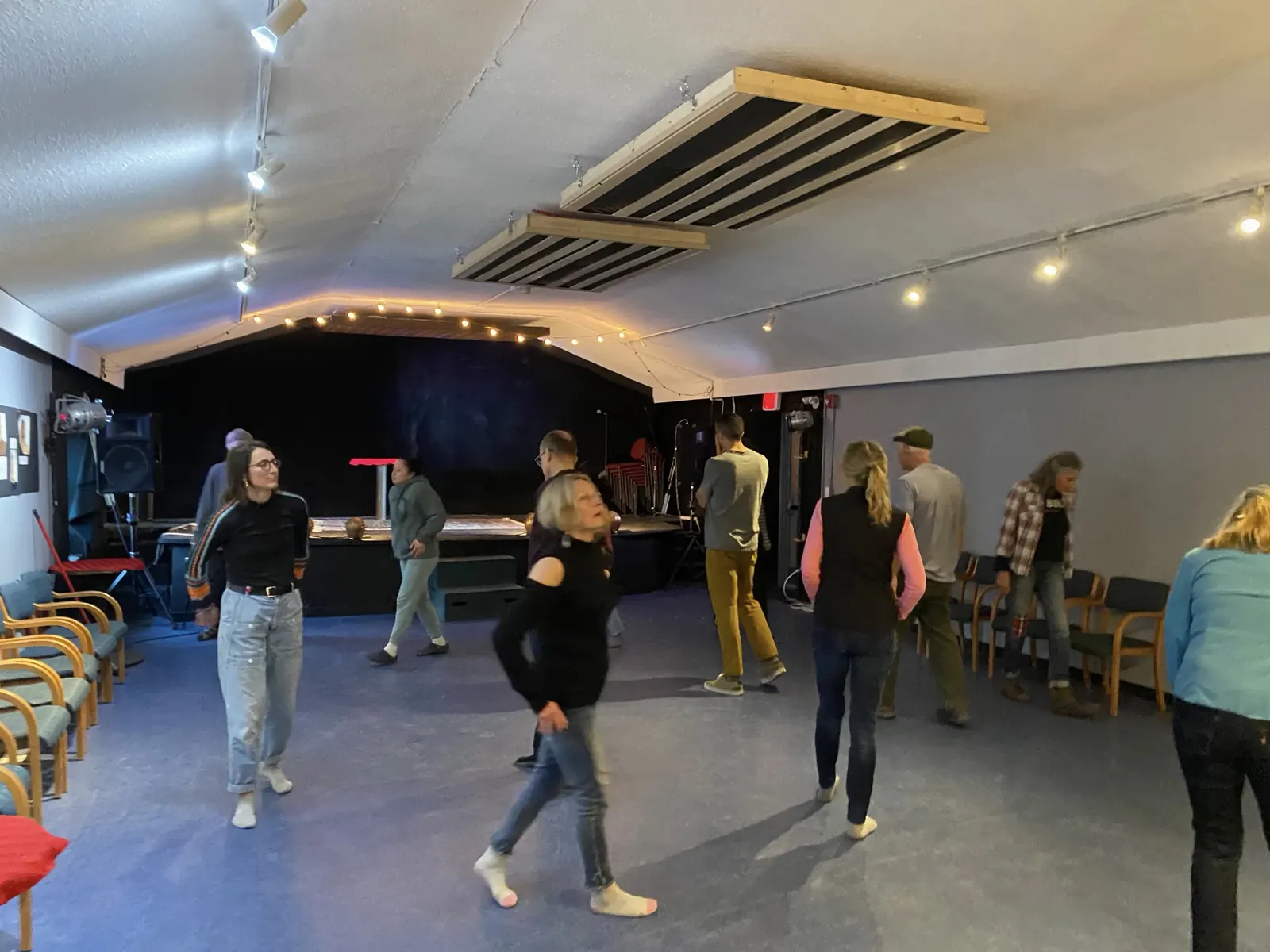
Moving to a new country can be lonely. Vowel Play is a place to connect, release stress and belong – while you learn.
Laugh, cry, scream – play! Acting is a healthy outlet for everything you carry around.
Acting trains empathy, active listening and communication – in English and in life.
Any country, any faith, any background. We focus on great works and good craft, and we support each other.
Showcase nights for friends and family, where the whole company puts on a play together.
From past classes

About Isi
Actor · Teacher · Creator of Vowel Play
Isi’s bio is coming soon. This space will tell Isi’s story: the acting journey, learning English as an adult, and how Vowel Play was born.
Get in touch
New groups are being planned. Leave your details soon to hear about the next classes, free trial sessions and showcase nights.
Classes are in person, in small groups. Spanish speakers especially welcome – everyone is welcome.